Best Open-Source Feature Flagging Tools in 2026

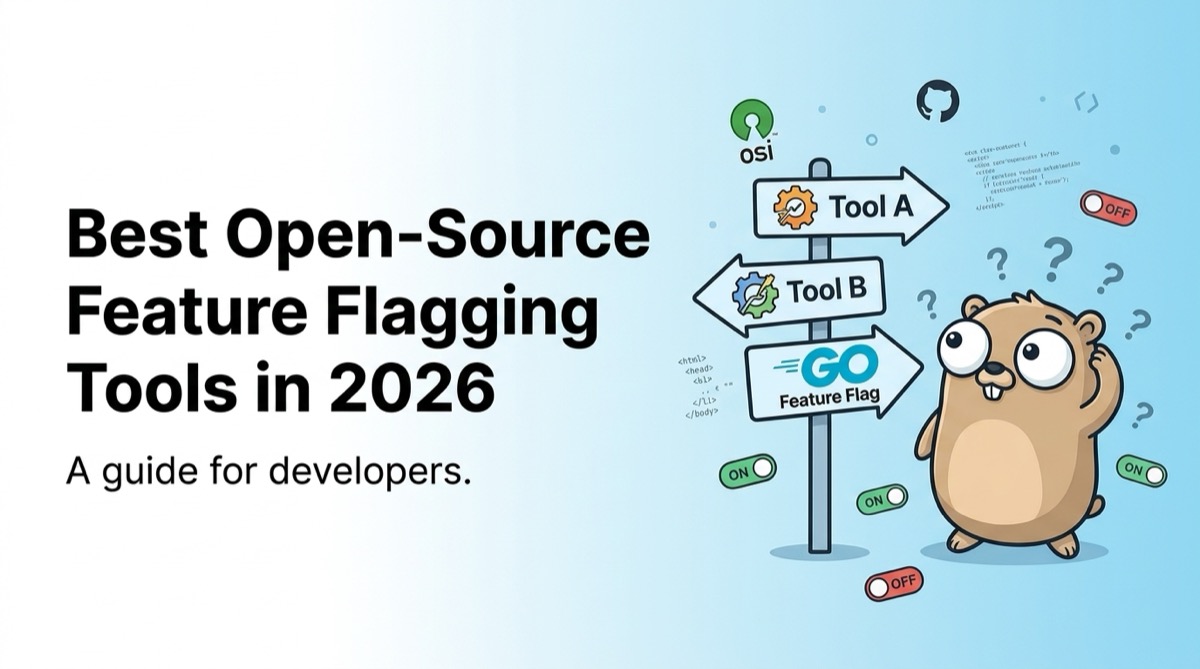
The real risk in 2026 isn't picking the wrong feature-flag tool — it's locking your codebase to one. Here's how the leading open-source options compare, judged through the OpenFeature standard for capability and true openness, not marketing.
The 2026 lens: lock-in, not features
Open-source feature flagging has matured. Targeting rules, percentage rollouts, and self-hosting are now table stakes — most tools on this list do them well. So the interesting question is no longer "which one has the most features?" It's "which decision will I still be happy with in three years?"
The thing that outlives your tool choice is the flag-evaluation code scattered across your services. If those calls are written against a vendor's proprietary SDK, switching backends later means touching every call site. That is the lock-in that actually costs teams.
OpenFeature — the CNCF vendor-neutral specification and SDK set — is the answer the category is standardizing on. It decouples the flag API in your application code from the backend that serves the flags. You write against the OpenFeature SDK once, then plug in a provider for whatever backend you run. Swap the backend later and your application code doesn't change. That makes OpenFeature support a first-class selection criterion in 2026, not a nice-to-have — and it's the axis most listicles skip.
So this comparison weighs OpenFeature posture alongside the usual criteria. Two of the tools come straight out of the OpenFeature ecosystem: flagd, the official reference implementation that proves the standard, and GO Feature Flag, a production-grade, batteries-included OpenFeature-native backend. They're listed first because, on the 2026 lens, that's where they land.
How we evaluated
The tools
GO Feature Flag
The most complete OpenFeature-native backend — and one of the simplest to install, because there's no database to run.
GO Feature Flag (GOFF) is a self-hosted feature-flag solution built around OpenFeature from the ground up, with native providers across Go, Node/JS, Python, Java, .NET, PHP, Ruby, Swift/Android, Kotlin and web (React/Angular) — plus OFREP for anything else. Flags are plain configuration — YAML, JSON, or TOML — that GOFF retrieves and keeps in memory. With no database to provision, migrate, or back up, it's about as simple to install and operate as a feature-flag backend gets: run a single binary, point it at your config, done.
Best for: Teams that want OpenFeature-native flagging they can stand up in minutes — no database to run — that stays GitOps-friendly, fully open, and never paywalls a core feature.
Watch-outs: There is no runtime admin dashboard — GOFF ships a web flag editor for authoring and validating configs; management is otherwise GitOps-driven. Evaluation is over HTTP/OFREP.
License & hosting: MIT, fully open — no paywalled enterprise tier. Single Go binary (distroless images, Helm, Lambda); flags load from HTTP, S3, GCS, Azure Blob, Kubernetes, files, GitHub/GitLab/Bitbucket, MongoDB, PostgreSQL, or Redis.
GOFF also does the parts that matter past the basics: targeting rules, progressive and scheduled rollouts, A/B experimentation, data exporters (S3, GCS, Azure, Kafka, Kinesis, Pub/Sub, SQS, BigQuery, OpenTelemetry, webhook, file, logs) for usage analytics, and change notifiers (Slack, Discord, Microsoft Teams, webhook). It supports both remote evaluation (via the relay proxy) and in-process evaluation (a WebAssembly module embedded in the SDKs), so you can trade a network hop for local-latency reads.
flagd

The CNCF reference backend that proves the standard.
flagd is the OpenFeature project's own flag-evaluation daemon: a minimal, config-driven engine that demonstrates how an OpenFeature backend should behave. It reads flag definitions from files, HTTP, or gRPC sync sources and evaluates them with targeting and fractional rollout — no database, no extra services. As the reference implementation, it has first-party providers across the OpenFeature SDKs.
Best for: Learning OpenFeature, local development, and minimal setups where you want the standard with as few moving parts as possible.
Watch-outs: It's intentionally not a management platform — no admin UI, no experimentation/analytics, no notifiers. You edit flag definitions directly and assemble the rest yourself.
License & hosting: Apache-2.0, fully open. Self-hosted Go daemon.
flagd and GOFF are allies in the same ecosystem, not rivals. The simplest way to think about it: flagd proves the standard; GOFF is what that standard looks like productionized — flagd's evaluation model plus retrievers, exporters, notifiers, and a multi-language provider set.
Unleash

A mature, widely-adopted platform with a polished UI — and a paid tier.
Unleash is one of the best-known names in OSS feature management, with a full admin
dashboard, SDKs across many languages, and a strong activation/gradual-rollout
model. OpenFeature providers for Unleash exist (JS, Java, Go) but live in the
community sdk-contrib repos rather than being vendor-maintained.
Best for: Teams that want a battle-tested platform with a rich management UI and are comfortable with the open-core model.
Watch-outs: It follows an open-core model — features like advanced RBAC and SSO sit in the paid Enterprise edition. Self-hosting requires PostgreSQL. OpenFeature support is light and community-maintained, Unleashed does not ship any native providers for OpenFeature.
License & hosting: Apache-2.0 core (open-core); self-hosted with PostgreSQL.
Flagsmith

A flag platform with a clear security/compliance posture and an official OpenFeature provider.
Flagsmith offers feature flags, remote config, and segmentation with a focus on governance and self-hosting for regulated environments. As an ecosystem member, it maintains its own (vendor-maintained) OpenFeature providers.
Best for: Organizations that prioritize compliance/governance and want vendor-maintained OpenFeature support out of the box.
Watch-outs: Self-hosting is heavier (requires PostgreSQL), and advanced governance/SSO features are part of the paid Enterprise edition (open-core). A/B testing typically leans on integrations rather than a built-in stats engine.
License & hosting: BSD-3 core (open-core); self-hosted with PostgreSQL.
GrowthBook

An A/B testing platform with strong statistics, where flags are one piece.
GrowthBook is built around experimentation: it connects to your data warehouse and runs Bayesian/frequentist analysis on experiments, with feature flags as the delivery mechanism. It maintains official OpenFeature providers (Go, Java, Python, .NET, Web/React). Its experimentation strength is real.
Best for: Teams whose primary need is rigorous experimentation and metric analysis tied to a data warehouse.
Watch-outs: Flag management is one part of a larger experimentation product; MongoDB is required to self-host, and governance features sit in commercial tiers (open-core).
License & hosting: MIT core with some commercially-licensed directories (open-core); self-hosted with MongoDB.
If experimentation and statistical analysis are the job, GrowthBook is a genuinely strong pick — more so than GOFF, whose experimentation pairs A/B rollouts with data exporters you analyze in your own stack.
Flipt

The tool closest to GOFF's niche: lightweight, Go, and loved by DevOps.
Flipt is a self-hosted, Go-based flag engine with a clean web UI. Flipt v2 went Git-native, storing flag state in a Git repository and removing the database dependency that v1 required — a GitOps model that lands close to GOFF's. It implements OFREP (usable from any OpenFeature SDK) and ships Flipt-specific providers.
Best for: DevOps teams that want a Git-native, low-footprint flag server with a built-in UI.
Watch-outs: It's intentionally narrower — no built-in experimentation/analytics engine — and the ecosystem is smaller than the bigger platforms. Licensing changed: the client is MIT, but the server moved to the Fair Core License (source-available, converts to MIT over time) — open in spirit, but not classic OSS.
License & hosting: MIT (client) / Fair Core License (server, source-available); v2 is Git-native (no DB).
PostHog

Feature flags as one module of a large product-analytics platform.
PostHog bundles product analytics, session replay, experiments, and feature flags. If you already run PostHog, its flags and experiments are tightly integrated with your analytics. OpenFeature support is third-party (community) and not vendor-maintained — some providers are dated.
Best for: Teams already invested in PostHog's analytics suite who want flags and experiments in the same place.
Watch-outs: Flags are a feature of a large platform, so self-hosting is heavy — PostgreSQL, ClickHouse, and Redis — and PostHog steers most users to its cloud. If you only need feature flags, this is a lot of infrastructure to operate.
License & hosting: MIT core with a separate enterprise directory (open-core); self-hosted with PostgreSQL + ClickHouse + Redis.
Featurevisor
Updated September 2026: Featurevisor now ships official OpenFeature providers across all its SDKs — this section has been corrected.
Flags as code, with no backend or database by design.
Featurevisor takes GitOps to its logical end: flag definitions live in your Git repo, a CLI builds static "datafiles," and you publish them to a CDN. There's no server to run and no database — your existing Git review and CI flow is the control plane. Alongside its own polyglot SDKs, every general-purpose Featurevisor SDK now ships an official, project-maintained OpenFeature provider — Node, browser, Go, Java, Kotlin, Swift, Python, Ruby, PHP, Rust and Elixir — each evaluating in-process from the datafile.
Best for: Teams that want maximal simplicity and a pure files-in-Git workflow, and don't need a management UI or hosted evaluation server.
Watch-outs: Minimal by intent — no management UI (it generates a read-only status site) and no managed evaluation server; you assemble more of the surrounding workflow yourself. Evaluation is in-process from a published datafile only, so a change ships through build → publish → client poll rather than taking effect the moment it's merged, and there's no server-side evaluation path for clients that can't carry a datafile. A/B tests can be defined declaratively, but there's no built-in statistical analysis.
License & hosting: MIT, fully open. No server, no database.
Featurevisor is a useful contrast: it makes GOFF's middle ground obvious. Both share the same instinct — no database, flags as config in Git — but GOFF ships the operational surface already built on top of it: a managed evaluation proxy speaking OFREP, so any OpenFeature SDK can evaluate with no datafile to build and distribute and a flag change takes effect as soon as GOFF picks it up; in-process evaluation too, via the WebAssembly module embedded in the SDKs, when you'd rather have local latency; plus progressive and scheduled rollouts, exporters for usage analytics, notifiers for change alerts, and a flag editor. Featurevisor is the minimal end of that philosophy; GOFF is the same philosophy with the rest of the workflow included.
At a glance
| Tool | License | DB required? | OpenFeature support | Built-in UI | Experimentation / A-B | Truly open (no paywalled core)? |
|---|---|---|---|---|---|---|
| GO Feature FlagRecommended | MIT | None | Native (ecosystem) | Config editor (no runtime admin UI) | A/B + data exporters | Yes — fully open |
| flagd | Apache-2.0 | None | Native (reference impl) | None (headless daemon) | No | Yes — fully open |
| Unleash | Apache-2.0 (open-core) | PostgreSQL | Community provider | Yes | Partial | No — paid Enterprise tier |
| Flagsmith | BSD-3 (open-core) | PostgreSQL | Official provider | Yes | Partial | No — paid Enterprise tier |
| GrowthBook | MIT (open-core) | MongoDB | Official provider | Yes | Yes — core strength | No — commercial tiers |
| Flipt | MIT client / FCL server | None (v2, Git-native) | Provider + OFREP | Yes | Partial | Source-available server |
| PostHog | MIT (open-core) | Postgres + ClickHouse + Redis | Community provider | Yes (full suite) | Yes | No — enterprise dir |
| Featurevisor | MIT | None (GitOps) | Official providers | None (Git/CLI) | Definition only | Yes — fully open |
built-in / fully supported · partial or with caveats · not available. OpenFeature posture and licensing verified against each project’s docs and the OpenFeature ecosystem (2026). “Official” = vendor-maintained provider; “community” = third-party provider.
How to choose
Feature-flag tooling isn't one-size-fits-all. A few common scenarios:
- You want OpenFeature-native flagging you can install in minutes and that stays fully open. This is GO Feature Flag's home turf: a single binary with no database to operate, MIT-licensed with no paid core, GitOps-friendly retrievers, native providers across many languages, and both remote and in-process evaluation. → GO Feature Flag.
- Experimentation with real statistical analysis is the primary goal. GrowthBook (warehouse-native stats) or PostHog (if you already run its analytics suite) will serve you better than a flag-first tool.
- You need enterprise governance, RBAC, SSO, and commercial support. Unleash or Flagsmith are mature open-core platforms built for that — just budget for the paid tier and a PostgreSQL deployment.
- You want pure GitOps with no server at all. Flipt v2 (Git-native server with a UI) or Featurevisor (CDN datafiles, no server at all) fit that brief.
The throughline: whichever you choose, write your application against OpenFeature. That's what keeps the decision reversible — and it's exactly why a tool's OpenFeature posture belongs at the top of your shortlist, not the bottom.
Try the OpenFeature-native option
GO Feature Flag is 100% open source (MIT) and runs as a single lightweight binary — with no database to provision, you can install it and have a flag evaluating in minutes.